
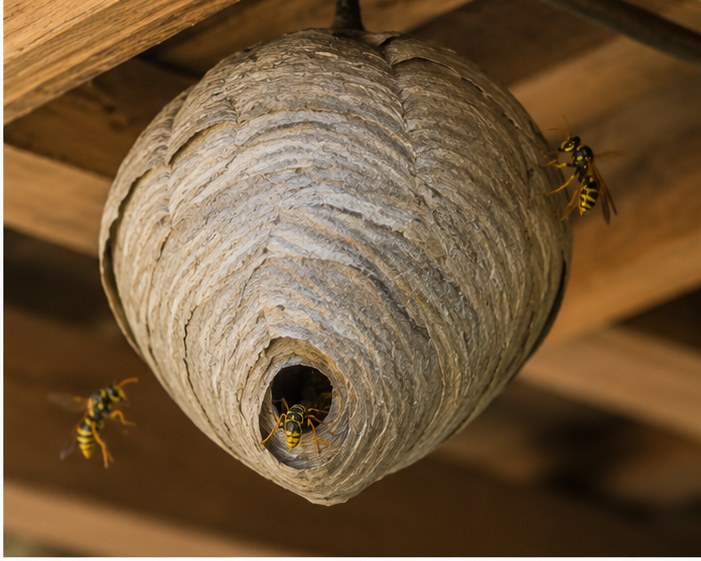
As the weather warms through spring and summer, wasp activity increases noticeably around Bricket Wood gardens and properties. A nest often goes unnoticed at first, tucked away in a quiet corner, but as the colony grows, both the nest and the number of wasps around it become much harder to ignore, especially on warm, still afternoons when workers are busy travelling to and from the entrance in a steady, repeated stream. Knowing what to look and listen for makes it much easier to catch a developing nest early.
Common places wasps build nests
- Roof spaces and lofts, particularly near eaves or gaps in soffits
- Wall cavities, accessed through small gaps in brickwork or airbricks
- Garden sheds, outbuildings and garages
- Under decking, in hedges, or within dense shrubbery
- Hollow trees or gaps in tree roots
What a wasp nest looks like
A mature wasp nest has a distinctive papery, layered appearance, often grey or beige in colour, and can range from the size of a golf ball in its early stages to considerably larger, sometimes reaching the size of a football or more, by late summer as the colony matures. It is typically rounded or oval in shape with a small entrance hole, and is built from chewed wood fibres mixed with saliva, giving it a papery, slightly ridged texture that is fairly distinctive once you know roughly what to look for around a property's roofline or garden structures. Because nests are frequently built in partly hidden locations, they can sometimes be heard before they are actually seen, with a faint background hum audible near the entrance on a quiet day.
Behavioural signs of a nearby nest and how to stay safe
Often the nest itself is hidden from view long before it is spotted directly. A consistent flight path of wasps entering and leaving the same gap in brickwork, roofline or shed corner is usually a strong indicator that a nest is nearby, and worth watching carefully from a safe distance. Noticeably higher wasp activity in one particular area of the garden, especially on warm, still days, is another useful clue worth following, rather than approaching the suspected entrance up close to investigate further, since wasps can become defensive if they sense their nest is under threat. Watching the same spot at different times of day can also help confirm a consistent pattern rather than a one-off sighting.
It is important never to approach, poke or attempt to remove a nest yourself. Simply observing flight paths from a distance, and noting where wasps seem to be entering and leaving a structure, is the safest way to help pinpoint a nest's likely location. Keep children and pets away from the area, and pass on the approximate location when arranging for the nest to be dealt with, along with any details of how long you have noticed the activity taking place. If you have spotted signs of a wasp nest around your Bricket Wood property, contact Atlas Pest Connect St Albans on 01727 400154 for prompt, professional advice and safe removal.
Need Wasp Control in Bricket Wood?
Atlas Pest Connect St Albans provides wasp control across Bricket Wood and the surrounding area. Get in touch for a free, no-obligation quote.