
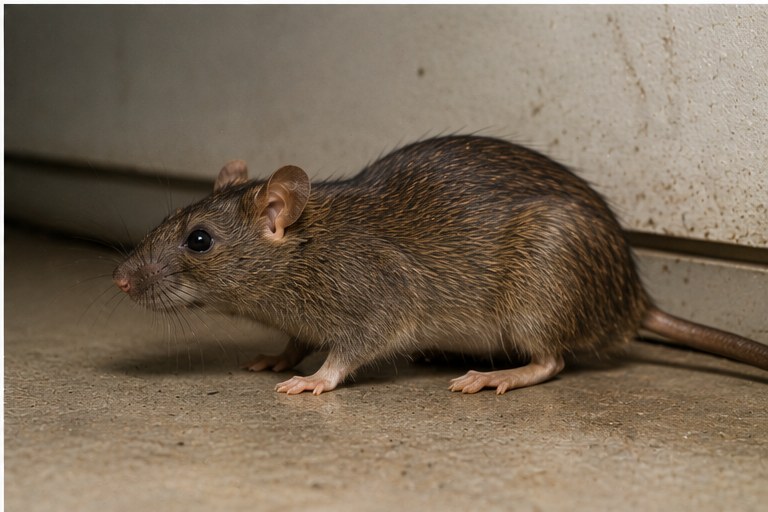
Rats are among the more concerning pests a London Colney household can encounter, and being able to recognise the early signs of activity can make a significant difference to how quickly and effectively the problem is resolved. Whether the activity is confined to the garden or has moved indoors, prompt identification is key to preventing a small issue from developing into a more established colony.
Physical Signs of Rat Activity
- Droppings that are noticeably larger than those of mice, often dark brown and tapered at the ends
- Burrows or holes around sheds, decking, compost heaps, or the base of garden walls
- Gnaw marks on wood, plastic, or cabling, sometimes affecting garden structures or bins
- Greasy rub marks along fences, walls, or skirting boards where rats regularly travel
- Trampled vegetation or worn pathways through longer grass or borders
Where Rats Are Commonly Found
In gardens, rats are often drawn to compost bins, bird feeders, sheds, and areas with dense vegetation or clutter that offer shelter and easy access to food. Around the home, they may seek entry through gaps in brickwork, damaged drains, or gaps around pipework, before establishing themselves in cavities, lofts, or beneath decking and outbuildings where they are unlikely to be disturbed. Overgrown areas at the back of gardens, and boundaries shared with neighbouring properties, can also provide convenient cover for rats moving between locations.
Behavioural Clues
Rats are largely nocturnal, so daytime sightings can sometimes indicate a well-established population where competition for food or shelter has pushed some individuals to forage outside their usual hours. Unusual pet behaviour, such as a cat or dog showing persistent interest in a particular area of the garden or a specific spot along a wall, can also be worth investigating further, as pets often notice rodent activity well before their owners do.
What to Do If You Spot Signs of Rats
Rats can cause damage to property and pose hygiene concerns, and colonies can grow quickly once established, particularly where food and shelter are both readily available. If you notice any of the signs above in your London Colney garden or home, it is important to have the situation properly assessed rather than relying on guesswork, as effective treatment depends on accurately identifying the extent and location of activity across the whole property.
Acting on early signs, rather than waiting until activity becomes more obvious, generally leads to a quicker and more straightforward resolution overall.
Distinguishing Rats From Other Garden Visitors
It can sometimes be difficult to tell rat activity apart from other garden wildlife, particularly when only droppings or a burrow entrance are visible. Rat burrows tend to be smoother and more compacted around the entrance than those made by other creatures, often with a clear, well-used path leading away from them. Droppings are also a useful indicator, being noticeably larger and more consistently shaped than those left by mice, and often found in small clusters near feeding or nesting sites rather than scattered at random across the garden.
For expert identification and effective treatment of rats in your London Colney property, contact Atlas Pest Connect St Albans on 01727 400154.
Need Rat Control in London Colney?
Atlas Pest Connect St Albans provides rat control across London Colney and the surrounding area. Get in touch for a free, no-obligation quote.